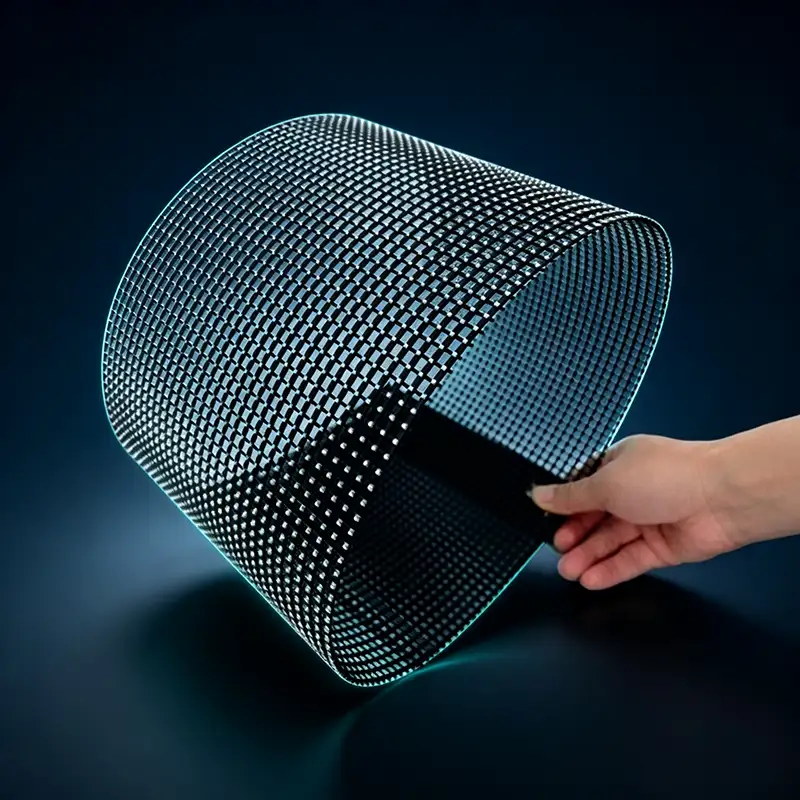
Dynamic information advertising display
LED strip surround screen
Five Pain Points, One Answer
Washout in bright sunlight — ads simply
don't work
Airports and stations feature extensive glass curtain walls — abundant natural
light also means intense direct sunlight. Standard screens lack sufficient
brightness — advertising footage washes out during daytime, making brand
messages unreadable. Advertisers refuse to pay for ad space that's
"invisible by day." Our transport hub screens deliver 5,000+
nits — ads remain vivid and sharp even under direct sunlight.
Auto-brightness adjustment ensures high visibility by day and soft glow by
night, maximizing every ad's reach.
Frequent equipment failures — ad space
sits "dark"
Transport hubs operate 24/7 — when a screen fails, ad playback stops and ad
space sits idle, directly impacting advertising revenue. Our screens
feature industrial-grade reliability with IP65 rating —
waterproof and dustproof. LED lifespan reaches 50,000-80,000 hours,
dramatically reducing failure rates and ensuring continuous revenue generation
from ad placements.
Lackluster visuals fail to engage
travelers
Travelers in lounges and waiting areas process large amounts of visual
information — ordinary screens fail to stand out in the visual competition. Our
screens deliver high refresh rates and high contrast — vibrant
colors, fine image quality. Coupled with creative content, effectively boosting
ad engagement.
Screen positions misaligned with
passenger traffic flow — low ad reach
Airports and stations have complex spatial layouts — traveler behavior and
viewing directions vary significantly by zone: waiting passengers sit and look
straight ahead, corridor travelers walk quickly, escalator riders move at an
angle. Fixed screens cannot be repositioned after installation — many ad
placements fail to cover actual passenger sightlines. Our screens support custom
sizing and flexible installation — wall-mount, hanging, pole-mount, and
other options based on specific zone requirements — ensuring screen orientation
precisely matches passenger viewing angles, maximizing actual ad reach.
Fragmented multi-zone management — high
maintenance costs
Transport hubs typically deploy dozens or even hundreds of advertising screens
across different zones — waiting areas, arrival corridors, commercial zones.
Traditional approaches manage each screen separately — content updates are
time-consuming and labor-intensive. Our solution supports centralized
unified management — all screen content can be scheduled and published
through a single platform, drastically reducing management costs.
Product Matrix
|
Solution
|
Best For
|
Key Advantage
|
Recommended Pitch
|
Brightness
|
Protection
|
|
Waiting Area Advertising Screen
|
Post-security lounges / waiting halls
|
Fine image quality, holds long-dwell
traveler attention
|
P2.5-P3.9
|
≥4,500 nits
|
IP65
|
|
Corridor / Arrival Area Advertising
Screen
|
Passenger corridors / baggage claim
|
High brightness, captures passerby
attention
|
P3.9-P6.25
|
≥5,000 nits
|
IP65
|
|
Outdoor Landmark Screen
|
Airport/station outdoor plazas
|
High brightness, waterproof,
landmark-level exposure
|
P6-P10
|
≥8,000 nits
|
IP65
|
Key Specifications
|
Category
|
Specifications
|
|
Display Performance
|
Brightness ≥4,500-8,000 nits (varies by
scenario) · High refresh rate, smooth visuals · Accurate color, vivid
advertising content
|
|
Protection
|
IP65 rating · Waterproof and dustproof
design · Supports 24/7 continuous operation
|
|
Lifespan
|
50,000-80,000 hours LED lifespan ·
Industrial-grade reliability · Dramatically reduced failure rates
|
|
Installation Flexibility
|
Supports wall-mount / hanging /
pole-mount / recessed installation · Adapts to different zone traffic flows
|
|
Content Management
|
Centralized management · Scheduled
switching · Emergency override capability
|
Installation Options
|
Method
|
Description
|
Best For
|
|
Wall-Mount
|
Fixed to wall
|
Wall ad placements in waiting areas
|
|
Hanging
|
Suspended from ceiling
|
Passenger corridors / commercial zones
|
|
Pole-Mounted
|
Standalone pole support
|
Outdoor plaza landmark screens
|
|
Recessed / Embedded
|
Flush with architectural structure
|
New construction or renovation projects
|